PostgreSQL
PostgreSQL 19 upgrade: what changes and what to check first
PostgreSQL 19 shipped on Nov 19, 2026 with REPACK CONCURRENTLY, JIT off by default and 22 incompatibilities. What blocks pg_upgrade and a safe order to migrate.
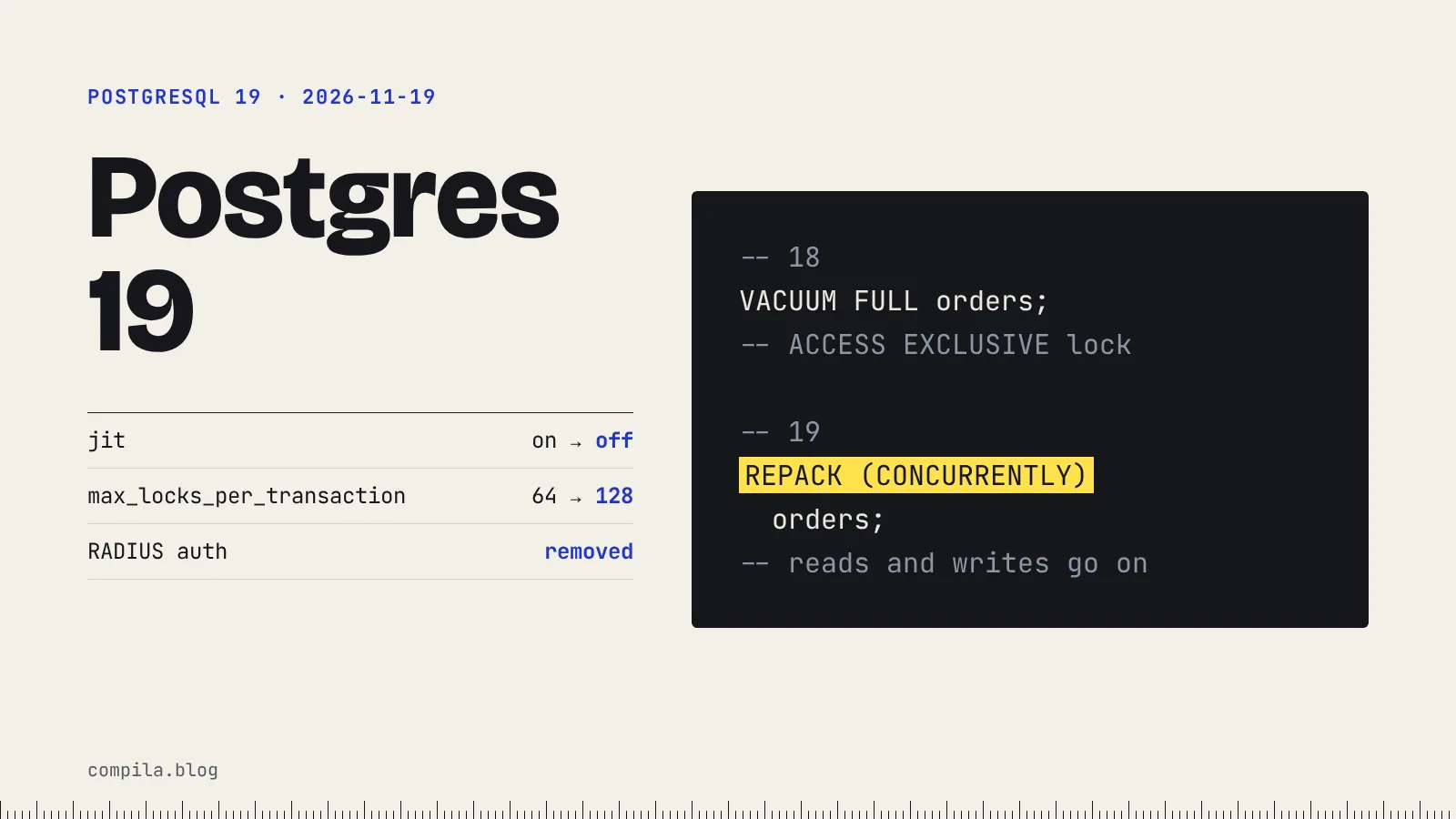
PostgreSQL 19 shipped on November 19, 2026 and is supported until November 19, 2031. For operators, the headlines are REPACK (CONCURRENTLY), which rebuilds a table without blocking reads and writes, and JIT turned off by default. For anyone planning the move, what matters are the 22 items under "Migration to Version 19" in the release notes.
There is a more urgent job first. A week earlier, on November 12, every supported branch got an update that fixes 52 security vulnerabilities and over 140 bugs. This post covers both, in the order you should do them.
Patch the minor version first, then plan the major
The November 12 update shipped 18.7, 17.12, 16.16, 15.20 and 14.25. Of the 52 CVEs, 32 are scored 8.8 under CVSS 3.1, the highest on the list. Several describe arbitrary code execution through type confusion or use-after-free, such as CVE-2026-6460, tied to ALTER ... SET DATA TYPE. A minor update needs no dump and no pg_upgrade: stop the server and update its binaries.
As with the Node.js security release of November 11, a line was left behind. The announcement says 14.25 is the final PostgreSQL 14 release, and the branch "is now end-of-life and will no longer receive security and bug fixes."
The announcement also lists post-update steps that apply even if 19 is far off for you:
- Reindex B-tree indexes on
bpcharcolumns declared without a length.char(n)columns are not affected. - Reindex GiST indexes that use the
gist_trgm_opsoperator class, if you usepg_trgm. - Reindex a GIN index if you suspect it was hit by one of the corruption bugs fixed here.
- If reading a table raises
missing chunk number, runREINDEX TABLE, which also reindexes its TOAST table. - If you use incremental backups, take a fresh full backup and use it as the new base.
If you skipped earlier minor releases, the announcement warns you "may need to run additional post-update steps" from those notes too.
Where each branch stands now
The versioning policy gives each major version five years of support. After November, the map looks like this:
| Version | Current minor | End of support |
|---|---|---|
| 19 | 19.0 | 2031-11-19 |
| 18 | 18.7 | 2030-11-14 |
| 17 | 17.12 | 2029-11-08 |
| 16 | 16.16 | 2028-11-09 |
| 15 | 15.20 | 2027-11-11 |
| 14 | 14.25 | ended 2026-11-12 |
On 14, the upgrade is no longer a roadmap item; it is an open fix. On 15, you have a year, and it is the next branch to go.
What can block pg_upgrade
The release notes are blunt: moving from any earlier release requires pg_dumpall, pg_upgrade or logical replication. Three incompatibilities stop the most common path:
- Names with line breaks. Version 19 rejects carriage returns and line feeds in database, role and tablespace names, and pg_upgrade refuses clusters that contain any.
- btree_gist on
inetandcidr. The default operator classes for those types are now the core GiST ones. pg_upgrade refuses clusters with btree_gist indexes on them, so recreate those indexes first. MULE_INTERNALencoding. It is gone. Databases using it need a dump and restore into another encoding.
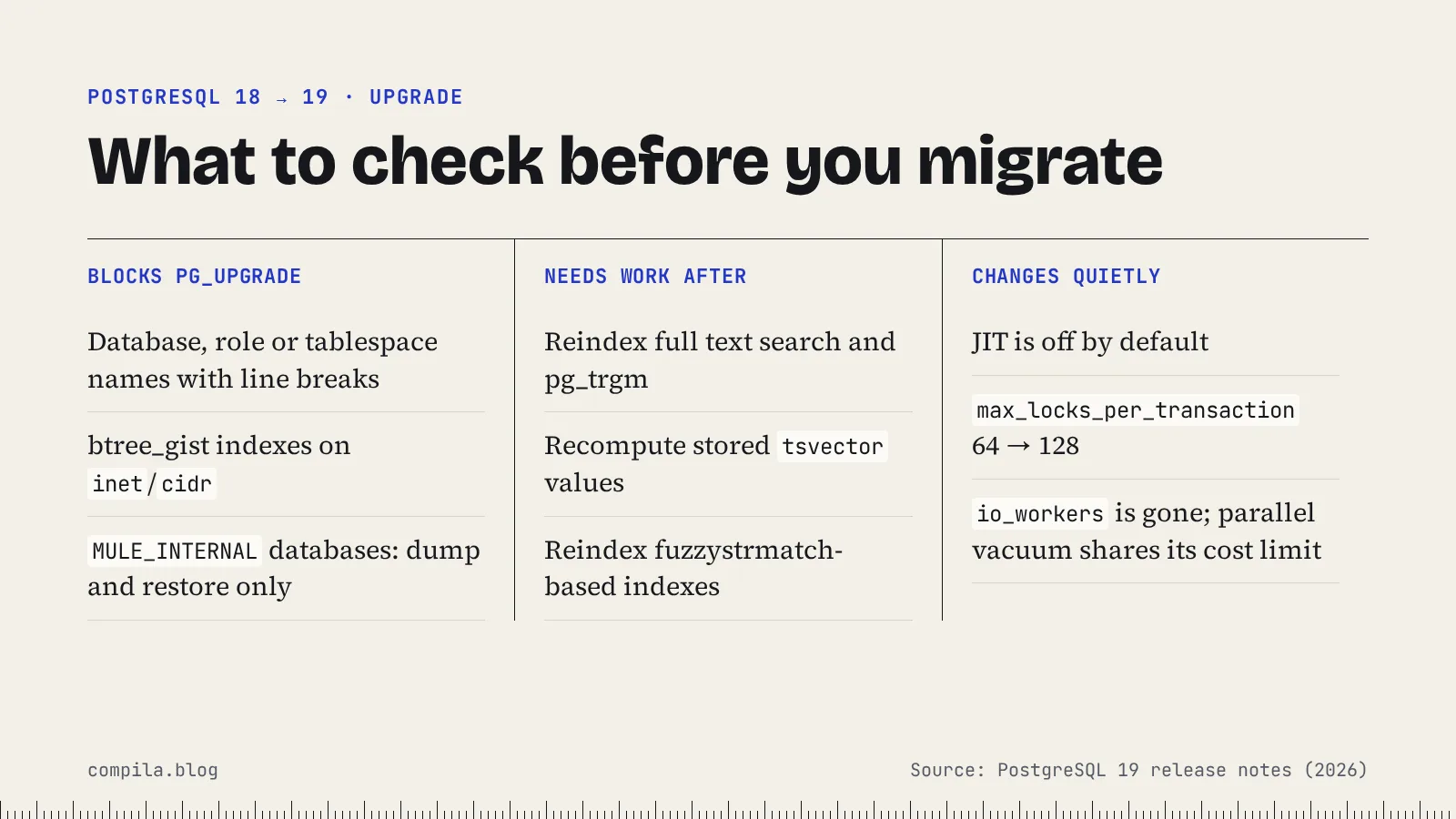
After pg_upgrade, text search needs attention. Full text search and pg_trgm now use the database's locale provider to classify characters, and the notes recommend reindexing and recomputing stored tsvector values. fuzzystrmatch changed how it handles non-ASCII characters, with the same reindex advice.
A catalog query like this one, run on the old cluster, lists btree_gist indexes on inet or cidr:
-- Run on the old cluster: indexes using btree_gist opclasses for inet/cidr
SELECT i.indexrelid::regclass AS index_name, oc.opcname
FROM pg_index i
JOIN pg_opclass oc ON oc.oid = ANY (i.indclass::oid[])
JOIN pg_am am ON am.oid = oc.opcmethod
WHERE am.amname = 'gist'
  AND oc.opcname IN ('gist_inet_ops', 'gist_cidr_ops');
Default changes that only show up in production
Some changes do not break the upgrade but change behavior the next morning.
JIT is off. The announcement says the cost estimates used to decide when to JIT "proved unreliable." The notes say sites running many large analytical queries must enable JIT by hand. If you run heavy reports, compare plans and timings before and after.
max_locks_per_transaction goes from 64 to 128. Lock size allocation changed, and the notes say settings must now be doubled to match their capacity in earlier releases. The new default does that for you; a value you set by hand in postgresql.conf needs doubling too.
io_workers is gone. Four settings replace it: io_min_workers, io_max_workers, io_worker_idle_timeout and io_worker_launch_interval. A postgresql.conf carried over from 18 with io_workers needs a review.
Parallel vacuum with cost delay may be slower. The leader and workers now share one cost limit, and the notes say such a vacuum "might run slower."
Authentication. RADIUS support is removed because PostgreSQL only supported it over UDP, which the notes call "unfixably insecure." Successful md5 logins now log a warning, which md5_password_warnings can turn off; md5 has been deprecated since 18 and the announcement recommends SCRAM. standard_conforming_strings is now always on.
Application-facing details. json_array() over zero rows now returns an empty JSON array instead of NULL. In pg_stat_subscription_stats, sync_error_count is now sync_table_error_count. The BufferPin wait event is now BufferCleanup, and BufferContent was replaced by BufferShared, BufferShareExclusive and BufferExclusive, which breaks dashboards that filter on the old names.
REPACK and the end of exclusive-lock VACUUM FULL
REPACK replaces VACUUM FULL and CLUSTER, both still available for compatibility. Without CONCURRENTLY, the REPACK docs say it takes ACCESS EXCLUSIVE at the start and holds it to the end.
With CONCURRENTLY, most of the work runs under SHARE UPDATE EXCLUSIVE, and ACCESS EXCLUSIVE is only taken in the final phase to swap the table and index files:
-- PostgreSQL 19: rebuild the table while reads and writes continue
REPACK (CONCURRENTLY) orders;

-- or in index order, like the old CLUSTER
REPACK (CONCURRENTLY) orders USING INDEX orders_created_at_idx;
There are limits. CONCURRENTLY does not work on partitioned or UNLOGGED tables, on tables without a primary key or index-based replica identity, inside a transaction block, or when max_repack_replication_slots has no room for another slot. The docs say the command fails if more than about 104 million rows are updated or deleted concurrently, and that it "is not MVCC-safe." Concurrent DDL on the table can also keep it from finishing.
What changes for people who write SQL
Two additions shorten application code that currently takes the long way round.
INSERT ... ON CONFLICT DO SELECT returns the existing row on conflict: get-or-create in one statement. The INSERT docs require RETURNING and a conflict target, and allow FOR UPDATE to lock the row:
-- PostgreSQL 19: returns the new row or the one that already existed
INSERT INTO distributors (did, dname) VALUES (11, 'Global Electronics')
    ON CONFLICT (did) DO SELECT
    RETURNING *;
The new WAIT command lets a session on a standby wait until an LSN is written, flushed or replayed, which gives you read-your-writes on replicas without polling. The announcement also lists JSON output for COPY, IGNORE NULLS in window functions, faster foreign key checks (bulk inserts "nearly 2x faster" in testing, per the announcement) and turning NOT IN into an anti-join when no NULLs are present.
What to do now
- Update every instance to 18.7, 17.12, 16.16 or 15.20 today, and run the reindex steps that apply to you.
- If you are still on 14, put the migration in the current sprint: 14.25 is the last release.
- For 19, restore a copy of the database in a test environment, look for the blockers above and rehearse pg_upgrade there.
- Review
postgresql.confforio_workers,jitandmax_locks_per_transaction. - Test heavy reports with JIT off, and move
md5logins to SCRAM. - Schedule the full text search and
pg_trgmreindex right after pg_upgrade.
The versioning policy promises minor releases "at least once every three months," so 19.1 should not be far off. For critical databases, waiting for it is a defensible call, as long as your current branch already has the November patch.
FAQ
Can I use pg_upgrade to go from PostgreSQL 18 to 19?
Yes. The release notes accept pg_dumpall, pg_upgrade or logical replication. pg_upgrade refuses clusters with line breaks in object names or btree_gist indexes on inet/cidr, and MULE_INTERNAL databases can only move by dump and restore.
Does PostgreSQL 14 still get security fixes?
No. Version 14.25, released on November 12, 2026, was the last one; the 14 line has been end-of-life since that date.
Does REPACK replace VACUUM FULL?
It replaces VACUUM FULL and CLUSTER, which remain available for compatibility. The practical difference is the CONCURRENTLY option, which rebuilds a table without holding ACCESS EXCLUSIVE for the whole run.