Node.js
Node.js November 2026 security release: what it fixes
Node.js 26.13.1, 24.22.3 and 22.23.5 fix 16 CVEs, seven rated high, mostly in HTTP/2 and TLS. Who is exposed, how to check, and what to upgrade.
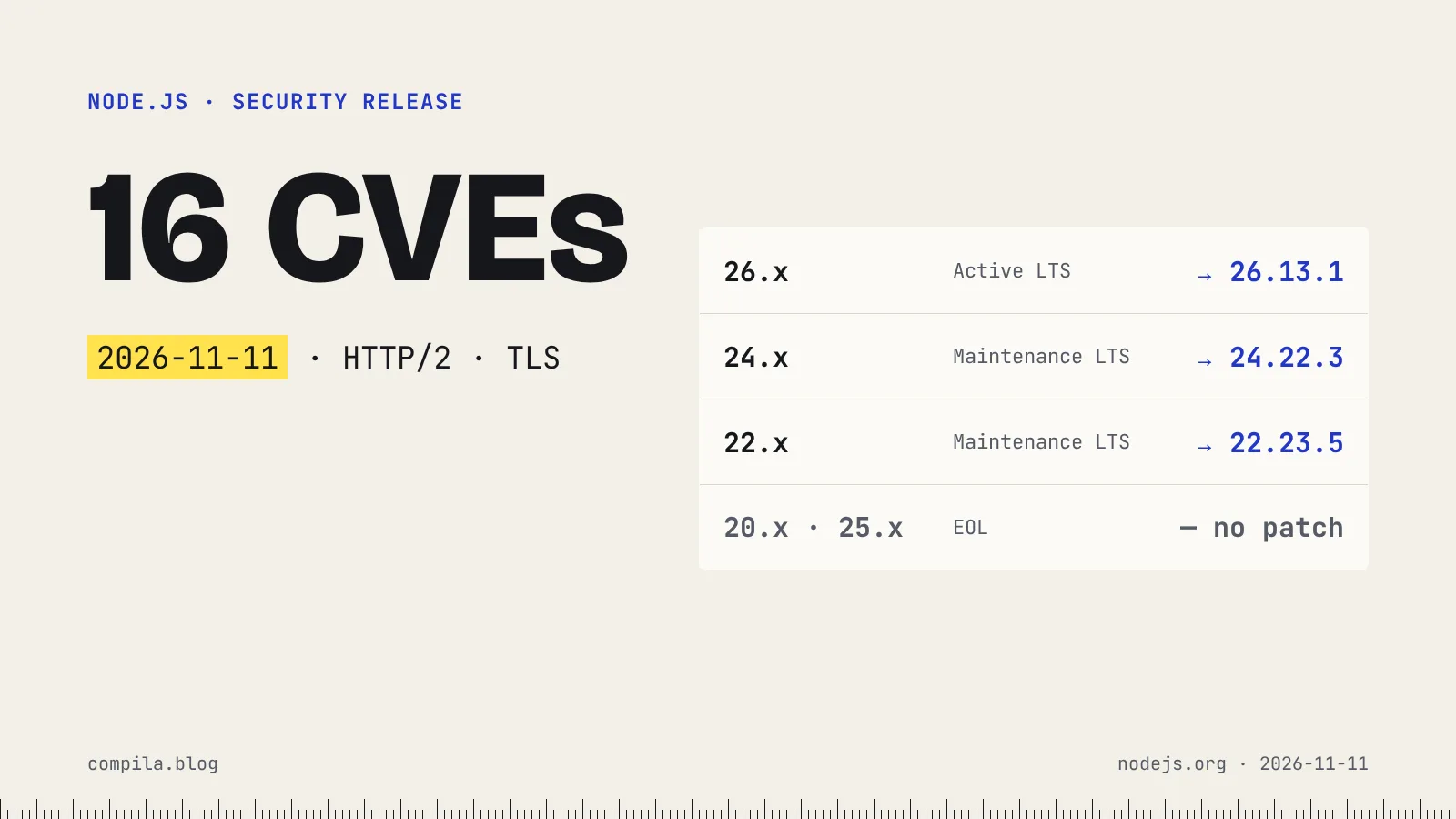
On November 11, 2026, the Node.js project shipped a security release for all three supported lines: 16 CVEs, seven rated high, six medium and three low. The fixed versions are 26.13.1, 24.22.3 and 22.23.5. If you run Node in production and have not upgraded yet, this is the patch to ship. If you are on 20 or 25, there is no patch for you.
Most of the weight is on the server side: 12 of the 16 issues are in HTTP/2 and TLS, and several of them crash the process or leak memory to an unauthenticated client. Here is what changes per line, who is actually exposed, and what to do this week.
Three fixed versions, two lines left behind
The Release Working Group schedule shows where each line stands. Node 26 became Active LTS on October 28, 2026. Node 24 moved to Maintenance LTS on October 20. Node 22 is in maintenance until April 30, 2027.
| Line | Status (Nov 2026) | Fixed version | End-of-life |
|---|---|---|---|
| 26.x Lithium | Active LTS | 26.13.1 | 2029-04-30 |
| 24.x Krypton | Maintenance LTS | 24.22.3 | 2028-04-30 |
| 22.x Jod | Maintenance LTS | 22.23.5 | 2027-04-30 |
| 25.x | EOL | none | 2026-06-01 |
| 20.x Iron | EOL | none | 2026-04-30 |
The advisory is blunt: "End-of-Life versions are always affected when a security release occurs". There is no backport for 20 or 25. If you are still on one of them, there is no version to move to inside that line; you have to change majors.
Not every CVE hits all three lines. According to the advisory, five of them affect only 24.x and 26.x (CVE-2026-123863, -123874, -126051, -123828 and -123868), so 22.x carries 11 of the 16. That does not change the advice: all three lines need the patch.
HTTP/2 and TLS carry the risk
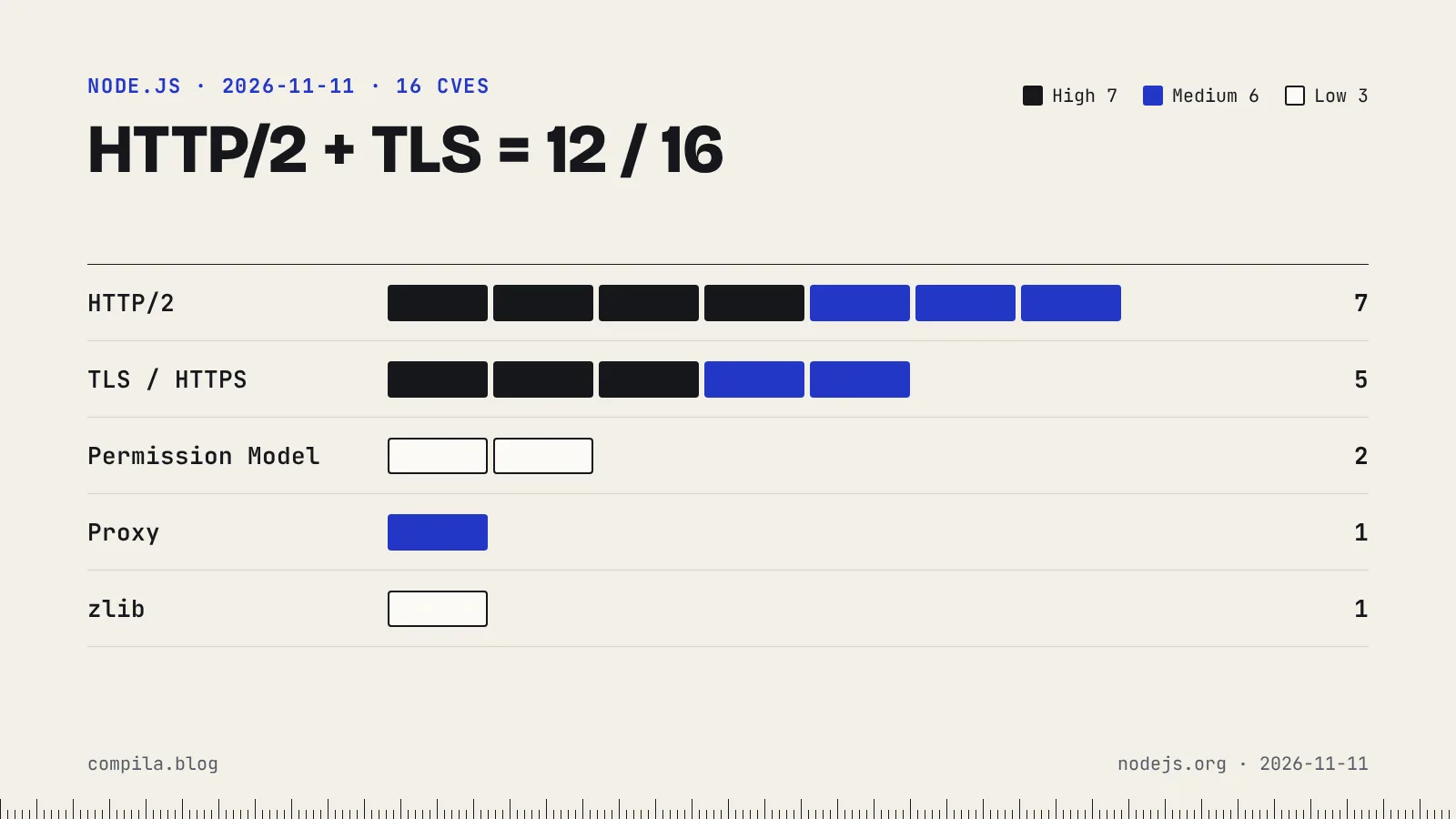
All seven high-severity CVEs are in HTTP/2 or TLS. The ones that deserve the most attention:
- CVE-2026-123864 (HTTPS, high). A zero-length TLS write makes the HTTP parser re-enter, and the server can copy its own heap memory into the response. The advisory says an unauthenticated client can read memory "including TLS private keys and other users' requests". The precondition: a handler that calls
res.flushHeaders()before the request body ends and later callsres.end()with a non-empty chunk, plus any route that echoes or stores a request body. The same text says cleartextnode:httpis not affected. - CVE-2026-123863 (HTTP/2, high, 24 and 26). A reachable assertion in session teardown aborts the process. Per the advisory, all it needs is a default http2 server whose handler responds before the request body has ended, which is typical. It is a variant of CVE-2024-27983 that the earlier fix missed.
- CVE-2026-123865 (HTTP/2, high). A protocol error during session shutdown leaves the socket in
CLOSE_WAITand the HTTP/2 state in memory indefinitely. The attacker starts the shutdown remotely withGOAWAY, so the leak is reliable against default servers. It is an incomplete fix of CVE-2026-48937. - CVE-2026-123872 (TLS, high). Over TLS 1.2, a client can renegotiate under a different
servernameand carry its client-certificate authentication to a host with a stricter policy. It only matters if you apply different client-certificate policies per hostname. The 24.22.3 release notes show the fix landed as three commits: no SNI change on renegotiation, none on resumption, and no resumption for mTLS without a session id context. - CVE-2026-126051 (TLS, high, 24 and 26). A TLS server that uses
SNICallback,OCSPRequest,newSession,resumeSessionorserver.addContext()can crash with an uncaught exception if the socket is destroyed before a deferred callback runs.
The other two high-severity issues are HTTP/2 use-after-free bugs: freed memory sent to the peer during stream teardown (CVE-2026-123866), and respondWithFile() streams used after they were freed (CVE-2026-123874).
HTTPS clients, proxies and the Permission Model are in scope too
Beyond the TLS issues above, five more CVEs do not depend on an HTTP/2 server or on server-side TLS:
- CVE-2026-123877 (medium).
https.Agentbuilds the same session-cache key for a request withoutcaand one withca: []. A TLS session authenticated against the default trust store can be reused by a request that should reject the server, and that request reportsauthorized === true. - CVE-2026-123871 (medium). Four
ERR_PROXY_INVALID_CONFIGerror paths print the proxy URL, username and password included. The advisory notes this ends up instderr, container logs and crash-reporting services. It is the remainder of an earlier fix, CVE-2026-48615. - CVE-2026-106071 and CVE-2026-123829 (low). Two Permission Model gaps: a wildcard rule such as
--allow-fs-read=/etc/passwd.*can also allow/etc/passwdunder certain conditions, and recursivefs.watchleaks file names inside denied directories on macOS and Windows. - CVE-2026-123862 (low). Destroying a zlib stream while
params()is pending throws an assertion error you cannot catch, which ends the process.
Dependencies changed as well
The release notes list dependency updates bundled with the patch. They matter if your tests rely on exact parser or HTTP client behavior.
| Line | llhttp | undici | sqlite |
|---|---|---|---|
| 26.13.1 | 9.4.4 | 8.12.4 | 3.54.1 |
| 24.22.3 | 9.4.4 | 7.30.2 | 3.54.1 |
| 22.23.5 | 9.4.4 | unchanged | 3.54.1 |
The 26.13.1 and 24.22.3 notes also include brotli 1.2.1; the 22.23.5 notes do not. These are patch releases inside the same major, so API changes are not expected, but run your test suite before promoting.
How to tell whether you are exposed
Start with the version that actually runs, not the one in package.json. Container images, managed runtimes and .nvmrc often disagree.
# On the host, in the container or in CI
node -p "process.version"

# In Docker images you already published
docker run --rm your-image:tag node -p "process.version"
Then check which surfaces your code touches. A grep covers most of it:
# HTTP/2 server and streamed file responses
grep -rnE "node:http2|require\(['\"]http2|respondWithFile|respondWithFD" src/

# TLS with deferred callbacks or per-host mTLS
grep -rnE "SNICallback|OCSPRequest|addContext|requestCert" src/

# https.Agent with an empty CA list
grep -rnE "ca:\s*\[\s*\]" src/
An empty result lowers your exposure but does not remove it. Frameworks and libraries can call these APIs for you. If TLS terminates at a load balancer and Node only speaks cleartext HTTP, CVE-2026-123864 does not apply by the advisory's own wording; the client, proxy and zlib issues still do.
What to do now
- Upgrade to 26.13.1, 24.22.3 or 22.23.5. Bump the base image tag,
.nvmrc, theenginesfield and the version pinned in CI, then redeploy. Changing code without rebuilding the image changes nothing. - If you are on 20 or 25, plan the migration. There is no upstream patch. The line with the longest support window is 26, supported until 2029-04-30.
- If you are on 22, put the date on the calendar. The line leaves support on April 30, 2027, a little over five months from now.
- Review logs that may hold proxy credentials. If your process ever failed with
ERR_PROXY_INVALID_CONFIG, the full URL may be in your logs; treat it as an exposed credential and rotate it. - Check who relies on
ca: []. If any client of yours uses an empty CA list on purpose, verify its behavior after the patch.
The advisory does not say any of these bugs are being exploited. That is no reason to wait: several CVEs in this release crash the process without authentication, and the fix is a version bump inside the same major.
FAQ
Which Node.js versions fix the November 2026 vulnerabilities?
Versions 26.13.1, 24.22.3 and 22.23.5, released on November 11, 2026. Any earlier version on those lines is still vulnerable.
Did Node.js 20 get a fix in the November 2026 security release?
No. Node.js 20 reached end-of-life on April 30, 2026, and the project states that end-of-life versions are always affected by a security release and get no patch.
Do I need to upgrade if I don't use the http2 module?
Yes. Nine of the 16 CVEs are outside HTTP/2, including bugs in HTTPS servers, mTLS and the https.Agent client.